
Ready to Start Your Career in Malta?
Explore job opportunities with Angel Jobs Malta and connect with employers looking for skilled candidates. Find your next opportunity and take the next step in your career journey.
21-Oct-2026
Planning to work in Malta can be an exciting step for your career. The country offers opportunities across technology, finance, hospitality, healthcare, Gaming, engineering, and other growing sectors. But before booking your flight or accepting a job offer, it is important to understand how employment and work-permit rules work in Malta.
For non-EU professionals, employment is closely connected to immigration status. Your right to work may depend on the specific employer, job, and permit under which you are employed. Understanding these rules before you move can help you prepare the right documents, understand your responsibilities, and avoid problems later.
Non-EU nationals generally need the correct employment authorisation to work legally in Malta. For many workers, this is handled through the Single Permit, which combines residence and employment authorisation.
A Single Permit is linked to specific employment conditions, including the employer and position. It is therefore important to check your permit conditions before starting work.
You can review the latest Malta Single Permit requirements through Identità
One of the most important things for non-EU workers to understand is that a Single Permit is not a general permission to work anywhere in Malta.
According to Identità, an employment-based residence permit remains valid when the main conditions on which it was issued continue to apply, including the specific employer, designation, and duration of employment.
If these conditions change, you may need to follow the appropriate procedure with Identità before continuing with the new employment
Before moving to Malta, make sure you understand what your employment contract actually says.
Your employment information should clearly cover important details such as:
Malta's Department for Industrial and Employment Relations (DIER) provides official guidance on the information employees should receive about their employment conditions.
Understanding your rights can make working in Malta easier. Employees are protected by employment laws covering wages, working hours, rest periods, leave, termination, and other employment conditions.
Normal full-time working hours are generally based on a 40-hour working week, although this can vary by sector. In 2026, Malta’s national minimum wage for full-time employees is €229.44 per week, with sector-specific conditions applying where relevant.
You can check the latest Malta employment conditions and minimum wage information before accepting a job.
If your employment ends, start understanding your options immediately.
Keep copies of important documents, including:
These can help you manage the next steps.
If you are a non-EU national planning to work in Malta, understanding the Single Permit system is essential. Third-Country Nationals (TCNs) from outside the EU, EEA and Switzerland generally need a Single Permit before starting employment.
Under the Malta Labour Migration Policy (2025), TCNs whose employment has ended may remain legally in Malta for up to 60 days while seeking alternative employment. This came into effect on 1 August 2025.
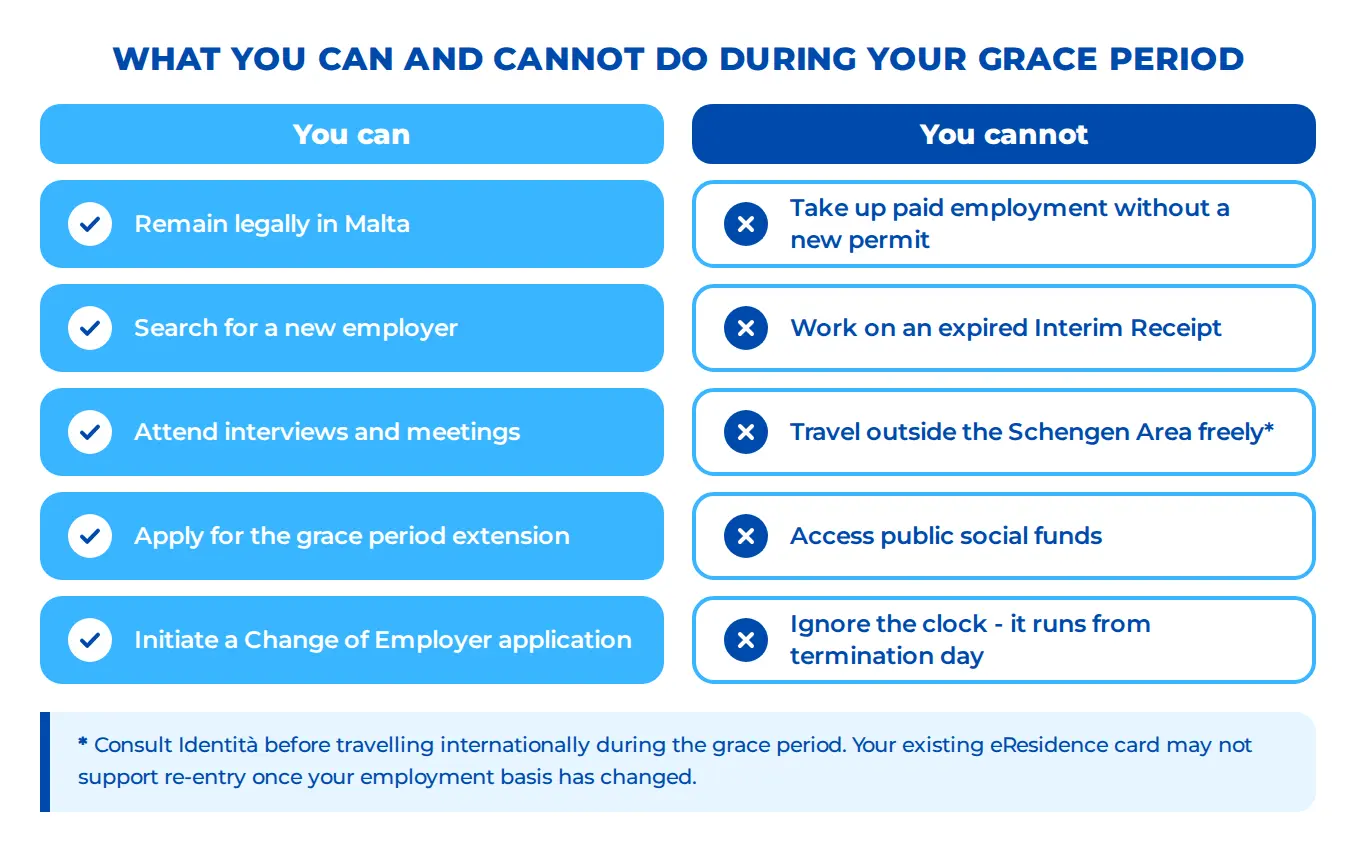
Before this reform, the period was 10 working days. The grace period applies specifically to TCNs holding a Single Permit and does not allow them to work freely. They must find a new employer and complete the required change-of-employer process.
Changing jobs can be different for non-EU workers because the Single Permit is linked to the specific employment. It does not automatically transfer to a new employer.
If you change employers, the new employer generally needs to submit a Change of Employer application through Identità. If your employment has ended, the application may be considered if submitted within 60 days of termination, subject to the applicable conditions.
The grace period does not allow you to start working for another company without the required authorisation .Complete the change -of-employer process before starting the new jobs
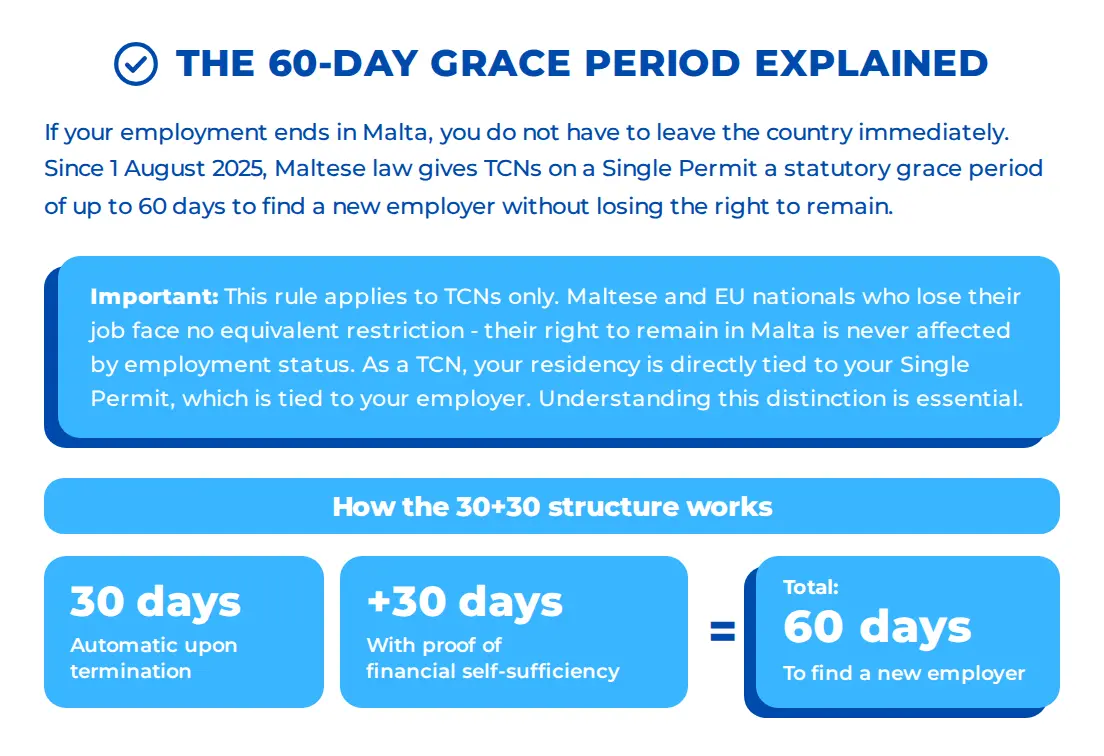
MPORTANT: This rule applies to TCNs only. Maltese and EU nationals who lose their job face no equivalent restriction - their right to remain in Malta is never affected by employment status. As a TCN, your residency is directly tied to your Single Permit, which is tied to your employer. Understanding this distinction is essential.
Finding another job quickly after leaving an employer can be important, but you should not start working simply because you have received a job offer.
The new employment needs to follow the relevant permit and authorisation process. Jobsplus states that employing a third-country national without the required employment authorisation is not permitted.
If you are changing employers, make sure you understand when you are legally allowed to begin working for the new company.
When in doubt,check with Identità or Jobsplus before starting the new role.
Keep digital and physical copies of important documents, including:
Also check expiry dates and plan renewals in advance.
This is one of the most important things to remember.
Your employment rights are mainly connected to Malta's labour and employment legislation, while your right to reside and work as a non-EU national can also depend on immigration and permit regulations.
For example, DIER provides information about employment conditions such as wages, working hours, leave and termination. Identità manages residence and employment-related permit matters for non-EU nationals.
Understanding both sides can help you avoid confusion when dealing with your employer, Jobsplus, or immigration authorities.
Before accepting a job, check:
Always use reliable and official information when checking the latest requirements.
Moving to Malta for work is an important career decision. Understanding employment rules, work permits, and your rights can help you prepare with confidence. Before accepting a job, always check the employer, contract, permit requirements, and employment conditions.
Angel Jobs Malta helps job seekers explore relevant job opportunities and connect with employers, while employers can use the platform to reach suitable candidates for their hiring needs.
Whether you are looking for your next career opportunity or hiring talent in Malta, Angel Jobs Malta can support your job search and recruitment journey.

Explore job opportunities with Angel Jobs Malta and connect with employers looking for skilled candidates. Find your next opportunity and take the next step in your career journey.