
Jobs in Malta Europe: Visa Process for EU/EEA Professionals
If you are an EEA or EU citizen, you can live, study, and work in Malta freely under the EU Directive and the Free Movement of European Union Nationals Regulations.
Do EU citizens need a Visa to work in Malta?
As a Eu citizen, you don’t need a visa or work permit to enter or work in Malta. However, if your stay lasts more than 90 days, you must register your residence with Identità, Malta’s official agency responsible for identity management and residence documentation for Jobs in Malta.
Full-Time Jobs Malta
Jobseekers can accept full-time Jobs in Malta Europe right away. Standard working hours for Eu professionals are about 40 hours per week, and an employment contract must meet the requirements of the Employment and Industrial Relations Act. Job recruiters are responsible for issuing a valid employment contract, while you handle residence registration if you plan to stay longer than 90 days to work in Malta.
Part-Time Jobs Malta
As an EU/EEA citizen, you can work part-time jobs Malta immediately upon arrival — no visa or work permit required. Most part-time Job positions involve work in Malta for about 20–30 hours weekly. Your jobs in Malta must comply with Maltese labour laws, and you should always keep a valid employment contract for reference.
Internships in Malta
In Malta, individuals aged 16 or above who have completed their final year of secondary education, as required under the Education Act, are eligible to take part in work placements,traineeships, internships, and apprenticeships. This eligibility aligns with national education and employment regulations.
Once you receive a confirmed internship offer from a Maltese organisation, university, or authorised job recruiter, you can travel to Malta using either your passport or national ID. The internship agreement must clearly define the job seeker’s role, duration, and learning objectives. If interns in Malta are studying, they can work up to 20 hours per week, depending on their agreement to work in Malta, as part of their internship or training programme.
Residence Registration for EU/EEA Citizens for Jobs in Malta
As a job seekers, if you stay in Malta for more than 90 days, you must register your residence with Identità (Expatriates Unit). Even as an EU citizen, you do not require a work visa to work in Malta, but residence registration remains mandatory.
Submit Form ID 1A along with:
- Proof of employment contract
- A valid passport or national ID
- Health insurance (EHIC – European Health Insurance Card or equivalent)
- Proof of accommodation
Once you submit your application, Identità will acknowledge it within 48 working hours and schedule an appointment for biometric collection. You can expect your eResidence card, confirming your legal right to live and work in Malta, to be issued within approximately 30 working days, provided all required documents are complete and in order.
With Angel Jobs Malta, a trusted online job portal, explore verified internships, part-time, and full-time jobs in Malta Europe through trusted job recruiters who help jobseekers build a safe, successful careers in Malta.
Jobs in Malta Europe: Visa Process for Non-EU/EEA Professionals
If you are a non-EU or non-EEA national planning to study, intern, or work full-time in Malta, you must obtain the appropriate visa and residence authorisation and work permit through Identità, Malta’s official government agency for residence and identity documentation. The process depends on the type of jobs in Malta full-time, part-time or internship in Malta.
Internships in Malta (Training or Study-Based)
If you are a non-EU/EEA national, you cannot undertake an internship in Malta without the appropriate visa, residence permit or work permit. In most cases, internships are only allowed if you are already studying in Malta or if the internship forms part of an approved training or study programme.
- If you are studying in Malta: A student must hold a Student Visa and a Student Residence Permit issued by Identità. The internship in Malta must be linked to your course of study.
- If the internship is a formal traineeship (linked to training or education): You must apply for a Trainee Residence Permit Malta through Identità before starting the internship.
Non-EU/EEA nationals cannot travel to Malta only for an internship without prior approval. You must first secure an internship or training agreement and obtain the correct visa, residence permit and work permit to train legally and live in Malta.
Part-Time and Full-Time Jobs in Malta Europe for Non-EU/EEA Professionals
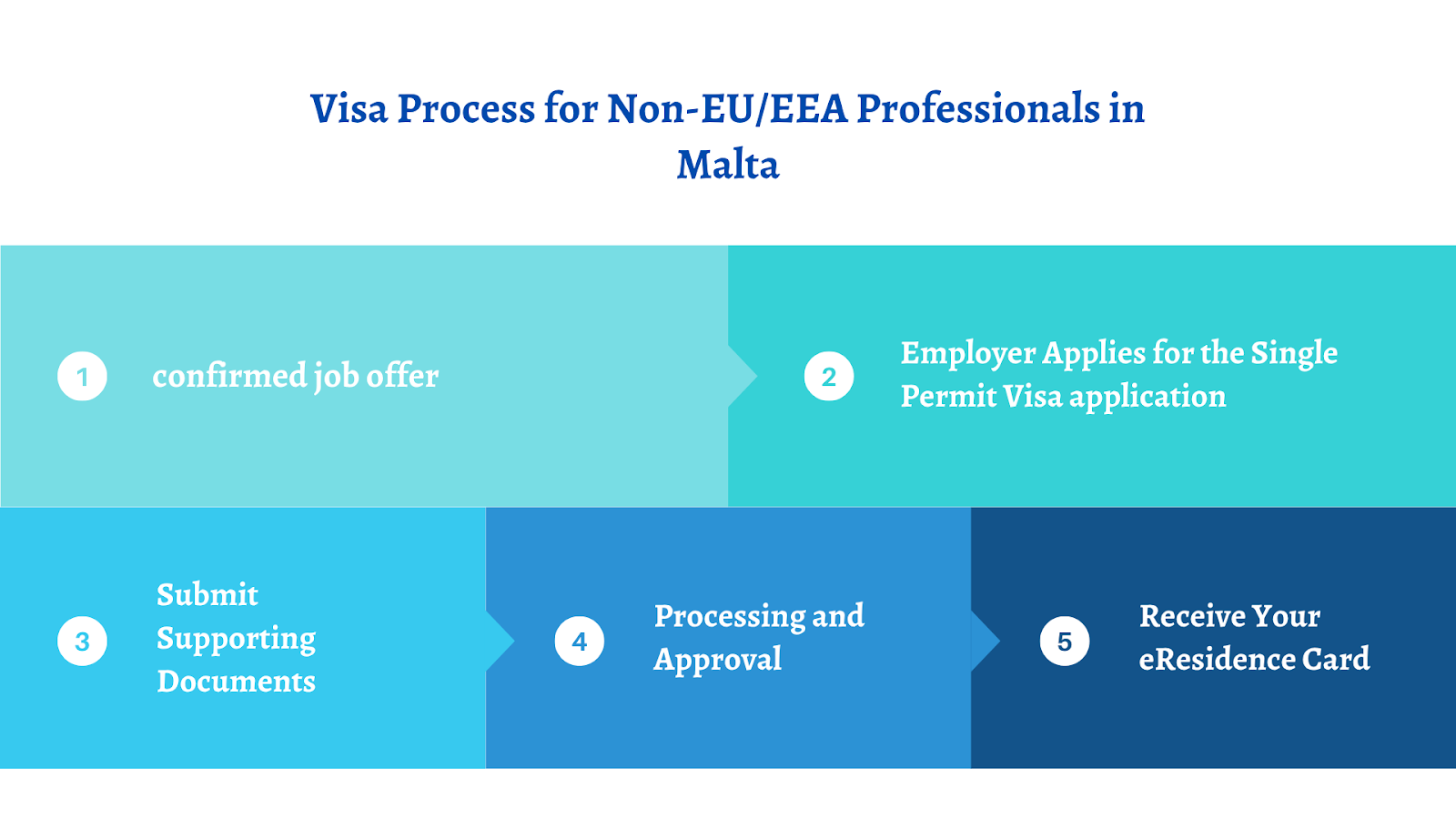
If you are a non-EU or non-EEA national planning to work in Malta, whether part-time or full-time jobs in Malta Europe, you will need a Single Permit. This document combines both your residence and work authorisation or work permit, allowing you to live and work in Malta legally under one process. There is no separate permit for part-time positions; the same system applies to both.
Step 1: Secure a Job Offer
You must first obtain a confirmed job offer from a licensed job recruiter. Your employment contract should clearly state the job title, duties, working hours, and salary to work in Malta.
- Full-time employment usually involves around 40 hours per week, following Maltese labour law.
- Part-time work typically refers to less than 40 hours per week, with flexible scheduling based on your agreement.
Only registered job recruiters in Malta can sponsor your Single Permit or work permit application.
Step 2: Employer Applies for the Single Permit
Your employer must submit the Single Permit application to Identità, Malta’s government agency responsible for identity and residence documentation. This application grants you both the right to live and work in Malta.
Authority: Identità – Single Permit Application
Step 3: Submit Supporting Documents
You’ll need to provide the following documents:
- Valid passport
- Signed employment contract
- Proof of accommodation in Malta
- Health insurance covering your stay
- Passport-sized photographs
- Certificates or qualifications (if required for your job)
- Completed Single Permit form, signed by both you and your employer
Step 4: Processing and Approval
Identità, in collaboration with Jobsplus Malta, reviews your Single Permit application to ensure compliance with national labour standards. The processing time typically ranges from six to eight weeks, although the law allows up to four months for a final decision, depending on your job type and the completeness of your documentation.
Step 5: Receive Your eResidence Card
Once your Single Permit Visa is approved, you will be invited for a biometric appointment. After completing this step, you will receive your eResidence Card, which serves as both your work and residence permit. The card is usually issued within 15 working days, remains valid for one year, and can be renewed if your employment continues.
At Angel Jobs Malta, a trusted online job portal, we connect international students, trainees, and professionals with verified institutions and trusted job recruiters across Malta. Our dedicated team provides expert guidance through every stage of the visa and permit process, ensuring a transparent, compliant, and stress-free experience. Whether you’re pursuing an internship, beginning your studies, or advancing your career, Angel Jobs Malta helps you learn, grow, and work in Malta with confidence.
Fast-Track Options
Malta offers accelerated permit options for skilled professionals, including:
- The Key Employee Initiative (KEI) — a five-day fast-track for roles earning over €30,000 annually.
- The EU Blue Card — for highly qualified professionals in specialised fields.
Browse the latest Jobs in Malta here at Angel Jobs Malta, a trusted online job portal: New openings!