
Malta’s labour system is built on a strong legal framework that ensures fair, transparent, and safe working conditions for all employees, EU/EAA or non-EU/EAA. These laws promote equal treatment, protect worker rights, and maintain balance between employers and employees across all sectors through established collective agreements, the Industrial Relations Act, and various subsidiary legislation.
At Angel Jobs Malta, a trusted online job portal, we guide professionals and job seekers in understanding Maltese labour standards while connecting them with verified employers who uphold fair, compliant and ethical contracts of employment.
1. What is the main employment law in Malta?
The primary law governing employment in Malta is the Employment and Industrial Relations Act. It sets out the rules for employment contracts, wages, working hours, leave, and termination. EIRA is further supported by Wage Regulation Orders (WROs), Organisation of Working Time Regulations, and Minimum Special Leave Entitlement Regulations, which provide industry-specific details on pay and working conditions.
2. Is a written employment contract mandatory to work in Malta for EU and non-EU professionals?
In Malta, employers are legally required to provide a written employment contract to all employees — including EU and non-EU working professionals — within eight working days from the employee’s start date. The agreement must clearly outline essential terms such as the job title, duties, working hours, salary, probation period, notice period, and leave entitlements, in compliance with the Employment and Industrial Relations Act, to legally work in Malta.
3. What are the standard hours to work in Malta?
In Malta, the standard work schedule follows a 40-hour working week, with variations set by each industry’s Wage Regulation Order (WRO). Under the Organisation of Working Time Regulations, the weekly limit is 48 hours, including overtime.
4. What is the minimum salary for jobs in Malta?
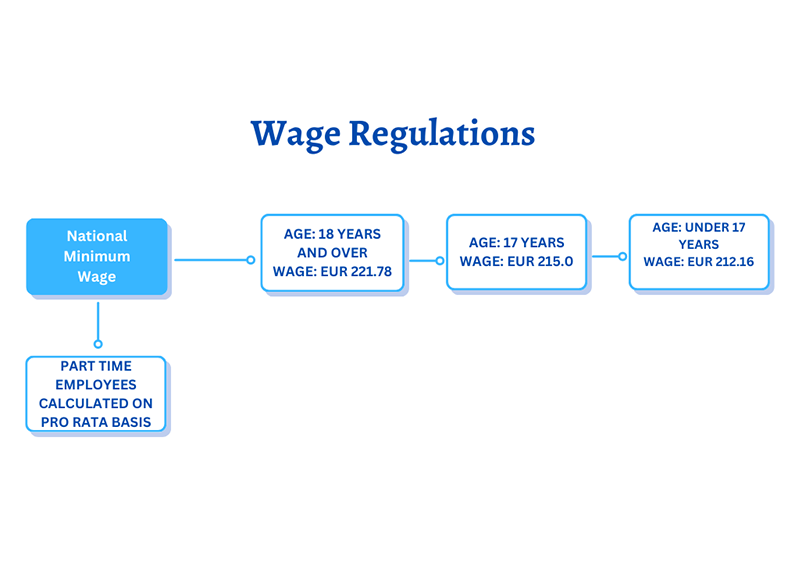
Malta enforces a national minimum wage that applies across sectorsfor jobs in Malta, with variations for specific industries under Wage Regulation Orders. As of 2025, the general minimum wage is €221.78 per week for employees aged 18 years and over, based on a 40-hour working week. For part-time employees, the wage is calculated on a pro rata basis, ensuring pay is equivalent to the hourly rate of a comparable full-time employee, as established by the Organisation of Working Time Regulations and Wage Regulation Orders.
5. What are the different types of employment contracts available to work in Malta?
There are two main types of employment contracts available to work in Malta:
- Indefinite Employment Contracts – These offer long-term job stability with no fixed end date, providing continuous employment under Maltese labour law.
- Fixed-Term Employment Contracts – These apply to a specific time period or project and end automatically when that period or project finishes. By law, employers must offer the same working conditions as indefinite contracts, unless there is a valid reason for different terms.
6. What are the rules on overtime and rest periods for jobs in Malta?
For jobs in Malta, employees are entitled to a daily rest of 11 consecutive hours and one day of rest per week. Overtime must be compensated either through additional pay or time off in lieu, as stated in the employment contract or relevant collective agreement.
7. What are the leave entitlements to work in Malta?
Every full-time employee is entitled to:
- Annual leave: Minimum of 24 working days per year
- Public holidays: Fully paid
- Sick leave: Minimum of two working weeks per year, supported by a medical certificate
- Maternity leave: 18 weeks, with 14 weeks paid by the employer
- Paternity leave:10 working days
8. Are foreign employees entitled to the same rights as Maltese nationals?
Yes. Maltese law ensures equal treatment and non-discrimination for all workers, regardless of nationality, race, gender, religion, or disability. Foreign employees enjoy the same pay, benefits, and protections as Maltese citizens.
9. How is termination of employment regulated?
Termination depends on the contract type:
- Indefinite contracts: Require a notice period based on length of service (1–8 weeks).
- Fixed-term contracts: Can only be ended early for a justified reason; otherwise, compensation may apply. Cases of unfair dismissal can be reported to the Industrial Tribunal, where the employee or trade union may represent the case.
10. What are the health and safety obligations for employers?
Employers must ensure a safe and healthy work environment under the Occupational Health and Safety Authority Act. This includes risk assessments, safety training, and appropriate equipment. Employees can refuse unsafe work without penalty, ensuring compliance with labour standards in Malta.
11. Which government bodies oversee labour compliance?
Labour standards in Malta are enforced by:
- Department of Industrial and Employment Relations (DIER) – Oversees working conditions and investigates complaints.
- JobsPlus Malta regulates work permits, employment registration, and job authorisations.
- Occupational Health and Safety Authority (OHSA) – Ensures compliance with safety regulations.
12. What are the penalties for non-compliance?
Following the 2025 amendments to the EIRA, penalties for breaches of labour law have increased significantly. Employers can face fines ranging from €2,000 to €7,000 per offence, with higher penalties for repeat violations, especially those involving unfair dismissal or unsafe working conditions.
Conclusion
Malta’s labour standards prioritise fairness, equality, and employee well-being. Whether you’re a local worker or an international professional, these laws ensure your rights are protected. At Angel Jobs Malta, a trusted online job portal, we partner only with licensed employers who comply with Maltese labour law, helping you build a safe, transparent, and rewarding career in Malta.
Browse the latest Jobs in Malta here at Angel Jobs Malta, a trusted online job portal: New openings!